

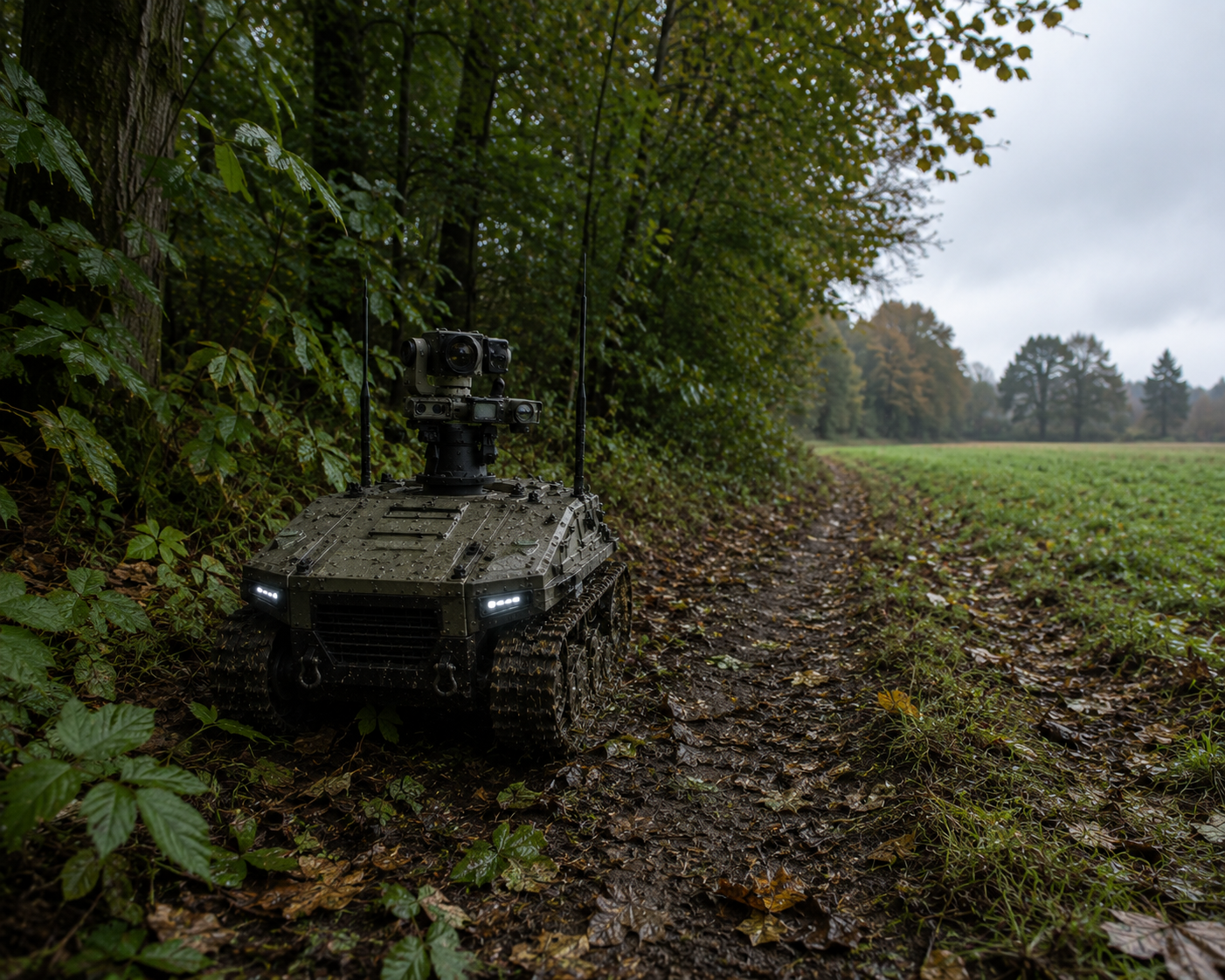
An Uncrewed Ground Vehicle (UGV) advances through wooded terrain, transmitting live video and sensor data to operators located far from the area of operation. The mission is progressing normally until the environment changes. Trees begin to obstruct the view to the sky, satellite performance degrades, and network conditions become increasingly uncertain.
In that moment, the vehicle’s intelligence, sensors, and autonomy matter little if communication is interrupted. For defence organisations deploying unmanned systems, the ability to maintain remote access is just as critical as the capabilities carried onboard.
As UGVs take on more demanding missions, connectivity itself has become a mission-critical requirement.
The problem: losing contact is not an option
Modern UGVs are expected to operate far beyond controlled environments. They traverse forests, urban areas, border regions, and remote terrain where network availability cannot be taken for granted.
Satellite connectivity has become an important enabler of beyond-line-of-sight operations, but it is not infallible. Dense vegetation, hills, buildings, and changing terrain can obstruct satellite signals. Even a temporary interruption can have serious consequences.
Operators may lose access to live video feeds. Commands may be delayed. Situational awareness can disappear at the exact moment when rapid decisions are required. Deployments often span countries with different cellular operators, varying infrastructure quality, and differing levels of network availability, and relying on a single operator or network introduces unnecessary risks. What works perfectly in one region may become unreliable just a few kilometres away.
In defence, uncertainty is unavoidable. Connectivity must be designed with that reality in mind.
The solution: staying connected when conditions change
Connectivity issues rarely arrive with a warning. A UGV moves from open terrain into dense woodland, and suddenly foliage obstructs satellite visibility. The vehicle crosses into another territory, and the local network performs differently than expected. In these moments, losing access for even a few seconds can mean losing situational awareness.
Rather than relying on a single network, the vehicle continuously uses every communication option available. As one path weakens, another takes over. Video keeps flowing, commands continue to reach the vehicle, and operators remain informed and in control.
Our STEER® software makes this possible by continuously evaluating network quality, aggregating, and orchestrating in real time across cellular, satellite, Wi-Fi, and other IP networks. This means that STEER® makes them work together as a single communications layer, allowing the vehicle to react to changing conditions without interrupting the mission.
For the operator, the experience is simple. They do not see networks switching in the background. They simply never lose access when it matters most.
Share this content:
Stellar and I-SEE enter partnership to extend adaptive communications to next-generation unmanned systems
INSIDE Stellar - Episode 5: Why remote teams still need to meet in person (real talk at 1AM)