

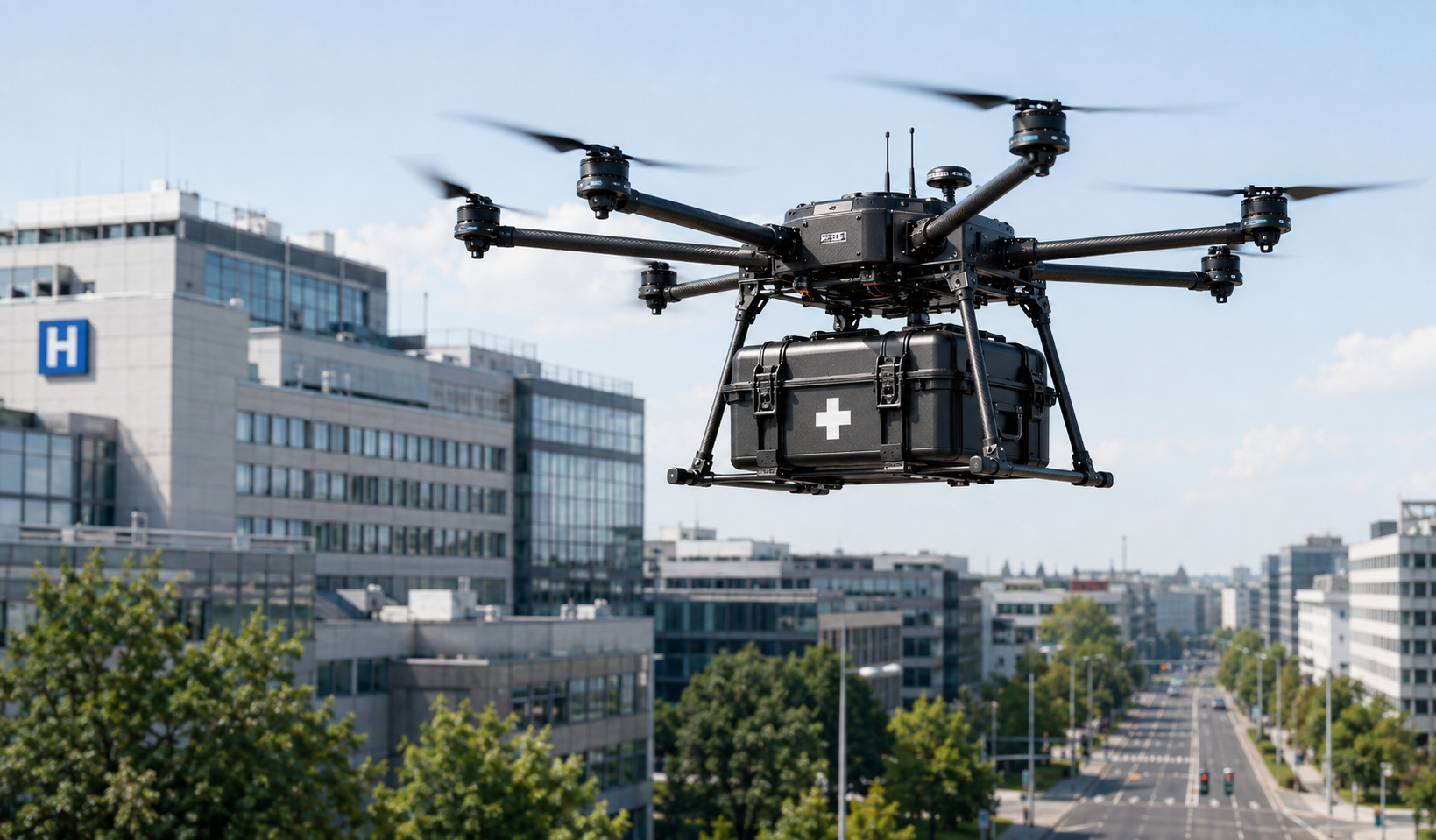
A medical drone lifts off from the roof of a hospital carrying blood for an emergency transfusion. It climbs above the city, avoiding traffic entirely as it flies towards another hospital several kilometres away. The route is fully autonomous, but the mission is far from unattended. Throughout the flight, operators monitor telemetry, camera feeds, battery status, and the condition of the medical payload, ready to intervene should anything unexpected happen.
Everything is going according to plan until the drone flies into an area where the mobile network changes. For most connected devices, a brief interruption might go unnoticed. For a BVLOS medical drone, it can mean losing visibility of the aircraft, interrupting telemetry, or preventing a remote operator from taking control. Suddenly, the invisible boundary between two mobile operators becomes a much bigger obstacle than any physical no-fly zone.
The problem: your drone is only as reliable as its connection
Drone manufacturers have already solved the challenge of autonomous flight. What they cannot control is the quality of the communication network supporting every mission. BVLOS operations require continuous connectivity. Even though the aircraft flies autonomously, operators must remain connected to monitor telemetry, camera feeds, payload conditions, and system health, while always being ready to take control if required. If that connection is interrupted, situational awareness disappears exactly when it may be needed most.
The challenge is that drones rarely stay within the coverage of a single mobile operator. During a single mission they may pass through multiple coverage zones, areas of network congestion, or even cross national borders. Connectivity should never become the invisible border of where a drone can safely operate.
The solution: connectivity without borders
Reliable connectivity for autonomous drones means more than staying online. It means maintaining continuous, low-latency communication wherever the mission takes the aircraft.
By orchestrating multiple networks into one resilient connection, drones can move seamlessly between operators without interrupting telemetry, command and control, live video, or payload monitoring. Rather than relying on a single network, connectivity continuously follows the best available path, allowing operators to focus on the mission instead of the signal.
When missions extend beyond terrestrial coverage, resilient connectivity can also integrate satellite communications into the same connection. Whether flying through dense urban environments, remote regions, or across international borders, communication remains available without requiring operators to think about which network is underneath.
Powered by Stellar
Stellar offers resilient connectivity across networks by orchestrating multiple communication technologies into a single, continuous internet connection. It enables reliable, high-performance connectivity in environments where traditional networks fail, including mobility, enterprise, and government.
For autonomous drone manufacturers, this removes one of the biggest barriers to scaling BVLOS operations. Cross-network connectivity ensures that telemetry, remote operations, payload monitoring, and mission-critical data remain available throughout the flight, regardless of changing coverage conditions. The result is infrastructure that supports safe, reliable operations instead of limiting them, allowing manufacturers to focus on advancing autonomous aviation rather than managing connectivity.
Share this content:
Industrial connectivity in manufacturing: Why every scan matters
Sovereignty is about operational control, not just geography